





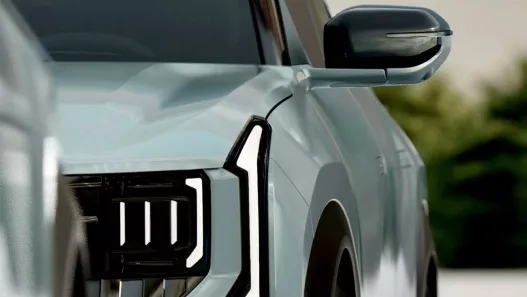

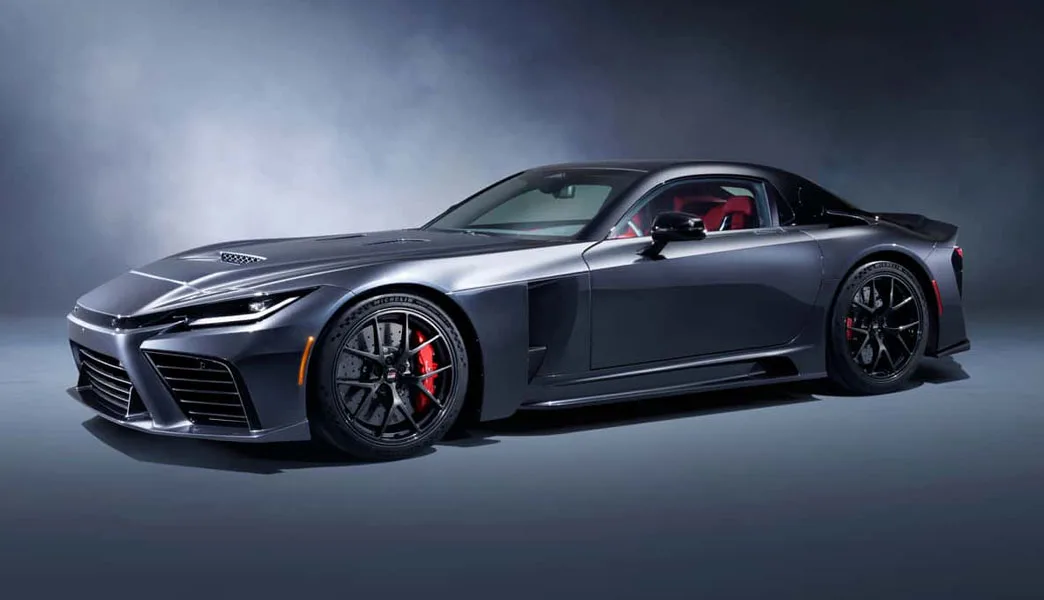
- Toyota has officially unveiled the GR GT, a next-generation sports car expected to launch around 2027, promising even more power and less weight as development continues.
- It is built on three key principles: low centre of gravity, lightweight but strong body construction, and advanced aerodynamics.
- Power comes from a 641-hp dry-sumped twin-turbo V8 (hot-vee layout) paired with a hybrid motor for instant torque, and an 8-speed transaxle with a wet-start clutch.
- The car features double wishbone suspension, forged aluminium arms, Michelin Pilot Sport Cup 2 tires, and Brembo carbon-ceramic brakes, offering sharp handling and high-speed stability.
- Inside, the cabin is race-inspired, with a very low seating position, excellent visibility, and driver-focused displays.
Finally, after the Toyota GR GT teaser video aired in Japan, the most anticipated sports car has been officially revealed. The GR GT is already extremely powerful.
However, Toyota says it is still developing the sports car, so it could become even more powerful and lighter by the time it’s launched around 2027. What makes the GR GT powerful and lighter?
Let’s find out in the article below.
Toyota GR GT: Engineered Around Three Key Performance Pillars

The Toyota GR GT is built around three key criteria: a low centre of gravity, a low weight with a strong body, and strong aerodynamic performance. And it also got plenty of power.
The sports car is equipped with a dry-sumped twin-turbo V8 engine that produces around 641 horsepower and 627 lb-ft of torque, beating the Porsche 911 Turbo S. This powerful engine feeds an eight-speed transaxle at the rear axle.
There’s also an electric motor added to fill torque and reduce lag. The GR GT’s top speed is rated at more than 199 mph. Toyota says these figures could improve before the production car arrives sometime around 2027.
New Engine & Hybrid Setup

Under the GR GT’s hood, the twin-turbo V8 is a hot-vee engine (Toyota’s first such design). It means the turbochargers will sit between the two sides of the engine. The engine sends power to the rear wheels and a mechanical, limited-slip differential through a carbon fibre torque tube.
Instead of a standard torque converter, the new 8-speed automatic transaxle uses a wet-start clutch for quicker response. Ahead of the transmission is an electric motor, so this is a hybrid.
It helps fill torque gaps, making acceleration smoother and faster.
Handling, Brakes & Tyres
The GR GT rides on 20-inch wheels, wrapped in bespoke Michelin Pilot Sport Cup 2 rubber (265/35 at the front, 325/30 at the rear). You’ll find Brembo carbon-ceramic discs that deliver immense, repeatable stopping power, even during repeated high-speed drives.
If you want to do big burnouts and make the tires smoke, the car’s multi-level stability control system will help you handle it safely, whether you’re a beginner or an expert. Its responsive handling comes partly from the double wishbone suspension setup at the front and rear, which uses strong, lightweight forged aluminium arms.
Interior: Built With Racing Logic

Inside, everything is placed for maximum driving focus. You sit very low, with a “roughly identical” centre of gravity to the car itself. Gauge width and height, as well as the positioning of displays like the upshift and gear selection indicators, are set so well that the driver can see everything easily while driving fast.
Visibility is also excellent. Toyota Motor Corporation ensured that nothing obstructed the driver’s view.
Designed for Performance First, Looks Later

You can make your own judgments about the styling from the images. However, Toyota didn’t design this car as most manufacturers do. Usually, designers start with a sketch and evolve it based on engineering requirements.
But here, aerodynamicists and World Endurance Championship engineers first decided the ideal shape and structure of the car. Only afterwards do the stylists shape the outer design. The team decided on an ideal layout for the all-new, all-aluminium frame and the CFRP-and-aluminium body.
Toyota also used stimulators in early development to validate decision-making. It ensured that serviceability was an essential criterion in the creation of the GR GT.
A Future Halo Car for Toyota

Toyota wants the GR GT to become a modern icon, similar to the legendary Toyota 2000GT from the 1960s, because the automaker first crafted components and the car in the virtual world.
Toyota says this won’t be a car that is nearly finished and then redeveloped from scratch, which means it could be less expensive than something like the Lexus LFA. The GR GT seems heavily aimed at competing with Porsche 911 GT3-level cars, both on racetracks and public roads.
Toyota GR GT Launch Date
The GR GT will be officially launched somewhere in 2027.
What are Your Thoughts?
Now, I want to hear from you:
- What excites you the most about the Toyota GR GT — its 641-hp twin-turbo V8, the hybrid setup, or the race-focused design?
- Do you think Toyota’s engineering-first approach (aero + structure before styling) is better than the traditional design-first method?
- With Toyota hinting at even more power and less weight before 2027, what upgrades would you like to see in the final production version?
- Can the GR GT realistically challenge cars like the Porsche 911 Turbo S or GT3 once it launches?
Share your thoughts and opinions in the comments section.
Sources: Autoblog


