





In this guide, I’ll break down some of the most practical, tried and tested tips for fuel-efficient driving. When I say ‘tried and tested,’ I’m not exaggerating.
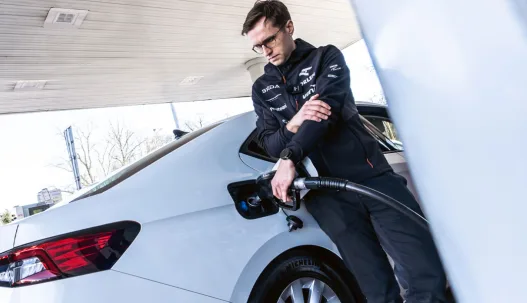
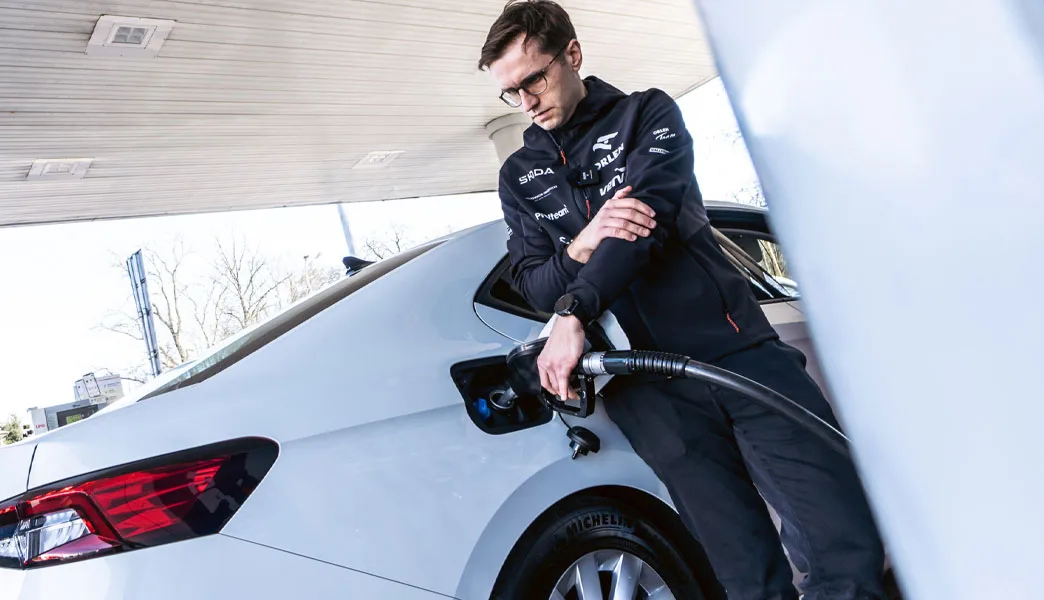
This year’s European Rally Champion, Miko Marczyk, has covered a record-breaking distance of 2,831 Kilometers in a single fuel tank in a standard Škoda Superb 2.0 TDI using some easy fuel-efficient driving tips.
Yes, you heard it right!
In a fourth-generation Škoda Superb, the 29-year-old Polish driver averaged just 2.61 liters of diesel per 100 Kilometers by maintaining a proper tire pressure, minimizing braking, using Eco mode, and driving well-rested.
He said, “Even an ordinary driver can achieve such a feat using these techniques.” Let’s discuss these tips thoroughly in the article below.
Miko Marczyk’s Record-Breaking Journey

Before getting to the topic, let’s go through the record-breaking journey of Miko Marczyk.
Marczyk is a Polish rally driver who won the 2025 FIA European Rally Championship. He began his rally career in 2016. Since 2017, Marczyk, along with his co-driver Szymon Gospodarczyk, has achieved all his major rally successes.
All his championship victories have been associated with Škoda vehicles. However, when the Polish driver is not on the rally circuit, he has an unexpected hobby: fuel-efficient driving. In everyday driving, Marczyk can cover immense distances safely and efficiently.
He spends over 12,000 Kilometers behind the wheel every year. Marczyk explained that rally racing is an expensive sport, and he drives so much to give more value to the partners who support him.
Unlike when he races, he never drives fast or recklessly on regular roads. In fact, he enjoys driving in a way that saves fuel. While testing how economical cars could be, the idea of a world record for distance driven on a single fuel tank began to form in Marczyk’s head.
This year, he turned the idea into reality, covering 2,831 kilometres on a single tank of fuel in his Škoda Superb 2.0 TDI. From Łódź, Poland, to Paris, France, and back to Poland, he averaged just 2.61 liters of diesel per 100 Kilometers.
The Polish driver shared some tips that helped him accomplish this feat.
7 Tips for Fuel-Efficient Driving
1. Maintain Proper Tire Pressure

According to Miko Marczyk, Tire pressure is crucial. He advised, “You have to stick to the manufacturer’s recommended tire pressure level, which is sufficient for low fuel consumption.”
If your vehicle’s tires are over-inflated or under-inflated, it can increase fuel consumption by up to 4%. It can even reduce the life of your tires by more than 10,000 Kilometers.
Marczyk emphasized that it is one of the basic but often overlooked rules of economical driving.
2. Accelerate Gradually and Minimize Braking

“You have to ease off the accelerator in time, and try to brake as little as possible,” Marczyk advises for fuel-efficient driving. You have to accelerate gently and gradually. The harder you accelerate, the more fuel you use.
To be as fuel-efficient as possible, you have to minimize acceleration and braking. You can take around 5 seconds to accelerate your vehicle up to 20 Kilometers per hour from a stop.
With this, the Polish driver adds another piece of advice that you have to anticipate the movement of other vehicles and drive in such a way as to minimize acceleration and braking, and maximize coasting time.
If you ignore what is happening ahead, you can end up frequently braking and then needing additional acceleration, which ultimately leads to more fuel consumption.
Similarly, you also have to anticipate the road features, such as traffic lights. If you see a red light coming, ease off the accelerator early instead of braking hard at the last moment.
For example, if you’re driving at a high speed and suddenly apply the brakes, you will lose more fuel as kinetic energy is much higher.
3. Drive Well-Rested
Another tip that helped Marczyk a lot in achieving the world record is driving well-rested. He said, “I always drive as rested as possible. I aim for seven to eight hours a night.” Sleep is essential for staying focused and making proper judgments for smooth, anticipated driving.
If you’re well-rested, you can stay alert to the upcoming situations like red lights or traffic jams and maintain a constant speed, all contributing to fuel-efficient driving. On the other hand, a fatigued driver is more likely to exhibit aggressive acceleration and braking, lowering the mileage by 10% to 40% in city traffic.
4. Familiarize Yourself With Your Vehicle

Familiarizing yourself with your vehicle is also essential to achieving fuel-efficient driving. Miko Marczyk spent time familiarizing himself with the car. He started the process by selecting the vehicle.
He chose the Škoda Superb 2.0 TDI for its 66-liter fuel tank (filled to the brim for the record) and excellent aerodynamics. The car has 110 kW of power, 360 Nm of torque, front-wheel drive, and a seven-speed DSG automatic transmission.
Moreover, the Superb weighs around 1,590 Kg, which helps to minimize the driving resistance. Marczyk received the car in November 2024. Before the world record attempt, he had already driven the car around 20,000 Kilometers.
He said, “Driving that much helped him a lot to understand the vehicle.” Marczyk made one modification: he installed Sportline springs, lowering the chassis by 15 millimetres, which improved the car’s aerodynamics.
The Superb comes with low rolling-resistance tires. Marczyk found that the brand-new tires are not ideal for fuel-efficient driving. So, it is better to wear them down slightly for low fuel consumption.
5. Maintain an Efficient Speed

Maintaining an efficient speed is essential for fuel-efficient driving. Marczyk maintained lower speeds of around 80 Km/h, where the powertrain is most efficient. However, an optimal speed varies with the type of vehicle.
It is usually reported to be between 56 and 80 Km/h. If you drive at a higher speed, wind resistance will play an increasing role in reducing the fuel economy of your vehicle. There are several factors affecting the speed and fuel efficiency, such as road capacity.
Several studies have shown that driving just above 72 Km/h when roads are congested allows the vehicle to move efficiently and results in less fuel consumption.
6. Utilize Favourable Wind Conditions
The aerodynamics of the Škoda Superb are so good that even at such a distance, a truck in front can shield you against headwinds.
So, utilizing favorable wind conditions, specifically a tailwind, helps for fuel-efficient driving by reducing the aerodynamic drag on the vehicle.
7. Use Eco Mode

Marczyk said, “I used Eco mode for smoother gear shifts and less sensitive throttle response.” Eco mode in cars is a setting that prioritizes fuel efficiency by adjusting vehicle systems like the engine, transmission, and air conditioning.
When you’re driving in Eco mode, it makes the gas pedal less responsive, causing the transmission to shift gears earlier, which keeps engine revolutions lower. It ultimately leads to less fuel consumption.
Wrapping Up
These simple tips helped the Polish driver achieve his record-breaking distance. You can also use them to make your everyday driving more fuel-efficient.
Despite this careful planning, Marczyk still sees room for improvement. He said, “Germany was a bit challenging, especially at night when the temperature was around 1 degree Celsius, which is not ideal for fuel consumption.”
There were also long uphill stretches of over 5 Kilometers, which also contributed to higher fuel consumption. While driving back through France, a 200-kilometer stretch with a tailwind helped the car to use less fuel, only 2.2 liters per 100 Kilometres.
After achieving this massive milestone, Miko Marczyk is now planning to surpass 3,000 kilometres on a single fuel tank, demonstrating his enthusiasm for economical driving. Not just with the fuel cars, he also wants to do this world record attempt with electric vehicles.
He already managed to drive 730 kilometres from Zakopane to the Baltic Sea in a Škoda Enyaq EV without charging, consuming just 11 kWh per 100 Kilometres. Marczyk said, “Electric cars are rapidly advancing in efficiency and range.” “Now, I’m curious to know what’s next,” he added.
The Polish driver is not just setting an example on the track, but also achieving new heights in defensive and economical driving.
Sources: Wikipedia, Skoda Storyboard
Frequently Asked Questions
1. Who is Miko Marczyk?
Miko Marczyk is a Polish rally driver and the 2025 FIA European Rally Champion. He’s known for setting a world record by driving 2,831 kilometers on a single tank of diesel in a Škoda Superb 2.0 TDI, using fuel-efficient driving techniques.
2. What Car Did Miko Marczyk Use for his Record-Breaking Fuel Economy Drive?
He used a fourth-generation Škoda Superb 2.0 TDI with a 66-liter fuel tank. The car has a 110 kW engine, 360 Nm of torque, front-wheel drive, and a seven-speed DSG transmission.
3. How Far Did Miko Marczyk Drive on One Tank of Fuel?
Marczyk drove 2,831 kilometers on a single tank of diesel, averaging just 2.61 liters per 100 Kilometers.
4. What are the Top Tips Miko Marczyk Recommends for Fuel-Efficient Driving?
Marczyk highlighted seven key tips:
- Maintain proper tire pressure.
- Accelerate gradually and minimize braking.
- Drive well-rested.
- Familiarize yourself with your vehicle.
- Maintain an efficient cruising speed.
- Utilize favorable wind conditions.
- Use Eco mode.
5. How Much can Proper Tire Pressure Improve Fuel Economy?
According to Marczyk, maintaining manufacturer-recommended tire pressure can improve fuel economy by up to 4% and extend tire life by more than 10,000 Kilometers.
6. What Speed is Best for Fuel-Efficient Driving?
Marczyk advised that maintaining speeds around 80 Km/h was ideal for fuel-efficient driving. Generally, most cars achieve optimal fuel economy between 56 and 80 Km/h.
7. Does Eco Mode Really Save Fuel?
Yes. Eco mode really saves fuel by adjusting your car’s throttle response, transmission shifts, and air-conditioning system. It makes the accelerator less sensitive and promotes smoother gear changes, reducing fuel consumption.
8. Can Ordinary Drivers Achieve Results Similar to Miko Marczyk’s Record?
While matching Marczyk’s exact world-record distance may be difficult, ordinary drivers can significantly improve mileage by following the same fuel-efficient techniques.
9. Can These Fuel-Efficient Tips Apply to Electric Cars Too?
Yes, many tips, such as smooth acceleration, proper tire pressure, and efficient route planning, also apply to electric vehicles. Marczyk himself achieved 730 Kilometers in a Škoda Enyaq EV without recharging.
10. Why is Driving Well-Rested Important for Fuel Efficiency?
A well-rested driver reacts smoothly and anticipates traffic better, which minimizes unnecessary braking and acceleration.


